
Weight Bearing Test (Quick Self-Test)
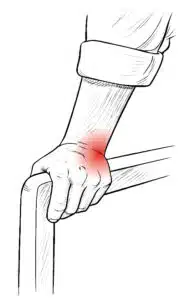
Weight Bearing Test is a simple way to check whether wrist pain on the pinky side of the wrist may be related to a TFCC injury.
Always test in this order: Healthy → Painful → With support
• Trusted by hand therapists • Used worldwide • Secure checkout
What you need
- A mechanical (dial) scale — not a digital one.
Why?
We are measuring how much force your wrist can push.
A dial scale measures pushing force instantly.
Digital scales are unreliable for this test.
How to perform the test
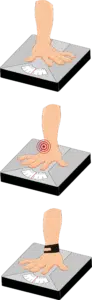
Step 1 – Healthy wrist (reference)
- Press straight down on the scale with your healthy hand.
- Keep your elbow above the wrist and fingers pointing forward.
- Write down the value.
Step 2 – Painful wrist
-
Press with the painful wrist.
-
Stop at the first sign of pain.
Step 3 – With the WristWidget®
The test can be performed with:
- WristWidget<sup>®</sup> or
- Two strips of non-elastic tape applied across the wrist as instructed by your therapist
If using WristWidget<sup>®</sup>:
- Make sure the ulnar head remains free in the opening.
- The opening should sit over the small bone on the pinky side of the wrist.
- Tighten it firmly so it feels supportive, but not tight enough to cause pain, numbness, or skin pressure.
Repeat the test and write down the new value.
Understanding the result
- If you can press more weight with less pain, your wrist is being supported.
- If there is no difference, check the fit and repeat the test once.
- If there is still no difference, seek professional advice.
Following recovery
If the support helps, repeat the test weekly.
Your measurements show recovery progress:
- First, the wrist with support equals the healthy wrist.
- Later, the wrist without support equals the healthy wrist.
When both wrists are equal without support, daily use is no longer needed.
Use support only for heavier loading if required.
Keep your measurements to guide activity progression.
Using tape instead of WristWidget®
If you do not have a WristWidget®, two strips of non-elastic tape can temporarily stabilize the joint for testing.
For detailed taping instructions and video demonstration, visit wristwidget.com.


