
TFCC Wrist Support for Ulnar-Sided Wrist Pain
Targeted support for TFCC-related wrist pain, without restricting natural wrist movement.
WristWidget® provides targeted TFCC wrist support without restricting mobility.
A conservative, non-surgical solution trusted by hand therapists and rehabilitation clinics across Europe.
Designed for clinical practice.
Easy for patients.
Developed for targeted TFCC support, WristWidget® is used by hand therapists across Europe. Its low-profile design provides functional wrist support while allowing natural movement during daily activities and rehabilitation.
WristWidget® provides functional TFCC support across Europe for clinics, rehabilitation professionals and patients seeking conservative DRUJ stabilization.
Understanding TFCC Injury and DRUJ Instability
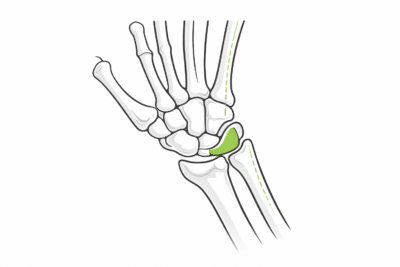
The Triangular Fibrocartilage Complex (TFCC) helps stabilize the wrist, particularly the distal radioulnar joint (DRUJ). Injury or irritation of the TFCC can cause pain on the ulnar side of the wrist and make gripping, twisting or weight-bearing activities uncomfortable.
When irritated or partially torn, common clinical signs include:
-
Pain during weight bearing (e.g. pushing up from a chair)
-
Clicking or instability with forearm rotation
-
Reduced grip strength
-
Persistent ulnar-sided wrist discomfort
Want to learn more about TFCC injuries, symptoms and diagnosis?
How WristWidget® Supports TFCC Rehabilitation
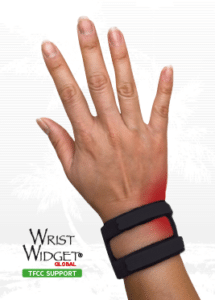
WristWidget® provides targeted support around the distal radioulnar joint (DRUJ) while allowing the wrist to move naturally. This makes it suitable for everyday activities as well as rehabilitation and a gradual return to loading.
Common clinical applications
-
Targeted TFCC support
-
Maintains wrist mobility
-
Low-profile and adjustable
-
For daily activities and rehabilitation
Trusted by Hand Therapists Across Europe
Developed by a certified hand therapist, WristWidget® is designed for use in clinical rehabilitation and everyday activities, providing functional TFCC support without restricting wrist mobility.
TFCC Injury – Frequently Asked Questions
Yes, many TFCC irritations and partial tears can be managed conservatively, particularly when instability of the distal radioulnar joint (DRUJ) is mild to moderate.
Conservative management typically includes:
-
Load modification
-
Targeted rehabilitation exercises
-
Gradual reintroduction of weight-bearing
-
External support to reduce strain on the TFCC
WristWidget® can be used as part of this approach by providing functional DRUJ stabilization without fully immobilizing the wrist. This allows patients to maintain movement while reducing mechanical stress on the irritated structure.
Severe or unstable tears may still require surgical evaluation.
Unlike rigid wrist braces, WristWidget® does not immobilize the wrist joint.
Traditional braces limit flexion and extension but often do not specifically address distal radioulnar joint instability. WristWidget® works differently: it applies targeted compression across the distal ulna and radius, helping approximate the joint and reduce strain on the TFCC during rotation and load transfer.
This allows:
-
Continued functional wrist motion
-
Use during rehabilitation exercises
-
Application during sports participation
-
More precise DRUJ support
It is designed as a functional support rather than a restrictive brace.
Yes. WristWidget® is commonly used during clinical weight-bearing assessment of suspected TFCC irritation.
For example, during the weight-bearing test (e.g. pushing up from a chair or table), therapists may compare symptoms with and without WristWidget®. A noticeable reduction in pain or instability while wearing the support may indicate that DRUJ stabilization reduces strain on the TFCC.
This can help guide conservative treatment decisions and patient education.
WristWidget® can be integrated at different stages of rehabilitation, depending on the clinical presentation.
It is commonly used:
-
During early load reintroduction
-
When progressing weight-bearing exercises
-
During return-to-work or return-to-sport phases
-
In patients who experience pain during rotational tasks
Because it allows functional motion, it can support gradual loading rather than replacing active rehabilitation.
Clinical judgement should guide timing and duration of use.
In many cases, yes.
WristWidget® is designed to provide stabilization without significantly restricting wrist mobility. This makes it suitable for certain sports and activities where rotational stability and load transfer are important.
However, suitability depends on:
-
Severity of the TFCC injury
-
Level of instability
-
Type of sport
-
Phase of rehabilitation
It may be used as part of a graduated return-to-sport protocol under professional supervision.
Many hand therapists choose to keep WristWidget® available in their clinic to ensure immediate support when TFCC-related wrist pain is identified.
Because WristWidget® is adjustable and available in a single size, it can be fitted directly during assessment. This allows therapists to:
-
Test symptom reduction during weight-bearing
-
Provide immediate conservative stabilization
-
Integrate support into early rehabilitation
-
Avoid delay between diagnosis and treatment
Having WristWidget® available in-clinic supports a smooth and continuous treatment pathway, particularly in active or return-to-sport patients.
Professional multipacks are therefore commonly used in clinical practice.


